For a school hundreds of kilometres from Darwin, ordering supplies is never just a quick order. Someone has to work out the stationery, the classroom resources, the office products and often the furniture, then get all of it delivered on time. Distance turns a simple order into a logistics job.
The stock has to travel, and in the Territory that means barge runs, long road trips and a wet season that does not wait. It is easy for one order to become a string of part-deliveries that trickle in over weeks. This article looks at why that happens, and how remote Northern Territory schools can make ordering school supplies simpler all year round.
The real problem is not the order, it is how it arrives
Most remote schools do not struggle to decide what they need. They struggle with how it turns up. A single order placed online can be invoiced in full, then shipped in whatever pieces the supplier can send that day, with the rest left on back-order.
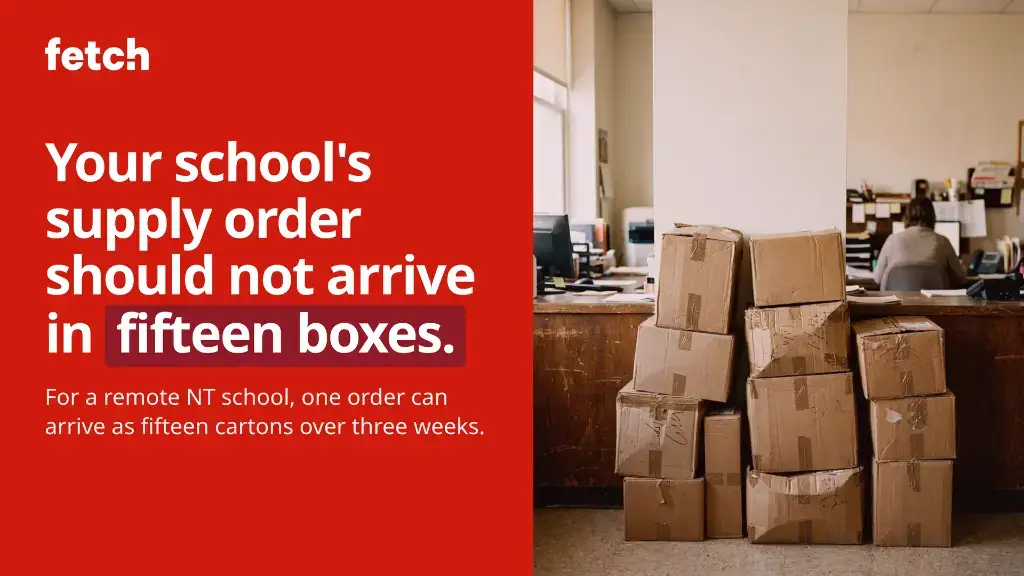
That is how a term’s worth of supplies becomes fifteen separate boxes arriving on different days. Rulers land in one carton, glue in another, and the reading books show up a fortnight later. Someone at the school then has to check every delivery against the invoice and work out what is still missing.
For a school in town, that is annoying. For a remote school, it is slow and expensive, because every one of those movements has to be freighted out to you.
Freight punishes the split order
Freight to a remote community is not a flat fee you can ignore. Each separate delivery is another consignment to pay for and another chance for something to go astray. When an order is scattered across many cartons, the school usually wears the cost of moving them all.
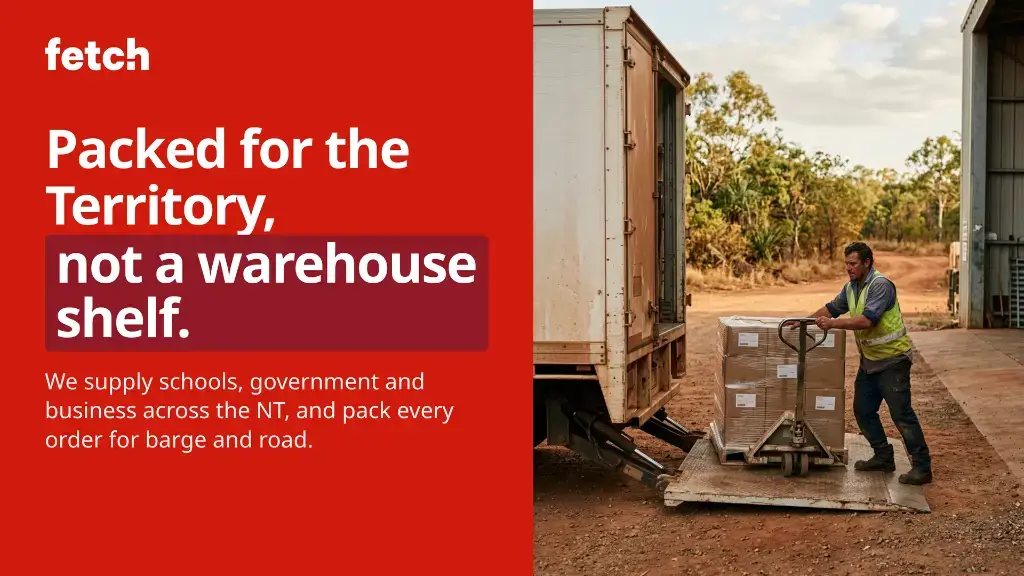
Packing matters just as much as the number of boxes. Stock packed for a warehouse shelf is not packed for an open barge deck, so it can arrive wet or knocked about after a run across the water. A supplier who does not think about that last leg leaves the school to deal with the mess when it lands.
Consolidation is the fix
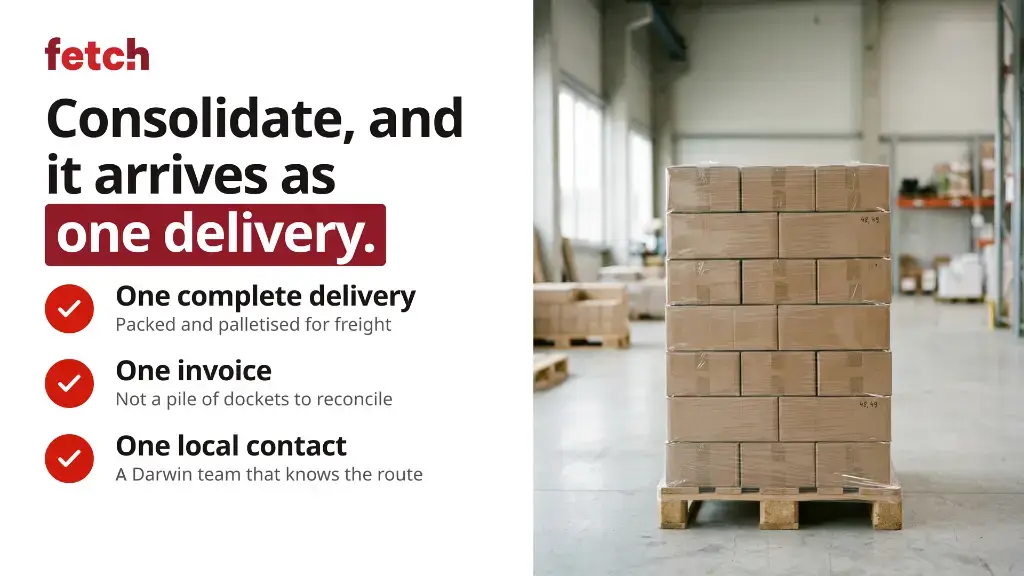
The simplest change is to stop shipping in pieces. When a whole order is consolidated, it leaves as one complete delivery, packed and palletised for the route it actually travels. One consignment, one arrival, one thing to check off.
Fetch builds orders this way on purpose. We pack for Territory freight, which means palletising and protecting stock for barge and road, so it arrives complete rather than split across a dozen part-deliveries. That is the difference between reconciling fifteen boxes and signing for one pallet.
One account, one invoice, one local contact
Consolidation is easier when everything sits with one supplier. A remote school is better off with a single account for stationery, classroom resources, office products and furniture than chasing three suppliers and three back-orders. One account also means one invoice to check, not a pile of them at the end of the month.
It means one local person to call, too. When a delivery is running late or a classroom needs something in a hurry, a school is better off talking to a Darwin team that knows the route than a call centre interstate. We are here, in the Territory, and we pick up the phone.
What switching actually looks like
Changing suppliers sounds like work, and that puts a lot of schools off. In practice it is light. You send Fetch your order list, or your usual order, we set up one account, and we handle the consolidation from there.
After that the pattern is simple. You place the order, we bring it together and pack it for your freight route, and you receive one complete delivery with one invoice. If something is not on your list, we can source it, because supplying schools, government departments and businesses across the Northern Territory is already what we do.
A simpler way to order, all year
Ordering for a remote school is not a once-a-year job. There are big orders and small top-ups, project orders and new furniture, and every one of them has to make the same trip out to you. The case for consolidating holds every time.
If you would like to see how Fetch compares, we can put together a comparison quote for your school’s orders. Even if you are happy with your current supplier, it costs nothing to see what a local Territory team can do. Reach out to the Fetch team and we will take it from there.
Comparison Quote Request
FAQ
Can a Darwin supplier deliver school supplies to remote NT communities?
Yes. Fetch supplies schools, government departments and businesses across the Northern Territory, and packs orders for the way remote sites actually receive freight, including barge and long road runs. Orders are palletised and protected for the trip so they arrive complete.
How can a remote school get one complete delivery instead of several part-deliveries?
Consolidate the order with a single supplier. When the whole order is brought together before it ships, it leaves as one complete, packed delivery rather than a series of boxes trickling in on back-order. That means one arrival to check instead of many.
What school supplies can Fetch provide?
Fetch covers stationery, classroom resources, office products and furniture through one account. Keeping the whole list with one supplier is what makes consolidation and a single invoice possible.
How does consolidating orders reduce freight costs for remote schools?
Freight is charged by the movement, so fewer, fuller consignments usually cost less to send than many small ones. Packing an order correctly for barge or road also cuts the risk of damage and replacement freight later.
How far ahead should a remote school place a large supply order?
Plan ahead of when you need the stock, especially for communities with limited delivery windows. Time to confirm the full list and the freight means fewer surprises and less chance of a gap in the classroom.
How do we compare our current supplier with Fetch?
Ask the Fetch team for a comparison quote on your order. There is no cost to compare, and it is a simple way to see the difference a local, consolidated approach makes.